Guide
How to write a lead magnet that earns the email
A lead magnet is a trade: your expertise for a stranger’s email address. It fails when it is too broad, too long, or too obviously a brochure. Here is the shape that works, and the sequence that follows it.
Short answer
Solve one specific problem for one specific person, in under 5,000 words, and deliver the result within a week of them reading it. Length is not the value; speed to a small win is.
What a lead magnet is for
A lead magnet exists to start a relationship with someone who has a problem you can solve. That is the whole design brief. It is not a portfolio, not a company overview, and not a book you happen to have written. If the reader finishes it and cannot do something they could not do an hour earlier, it has failed, however handsome the PDF.
The test: would someone pay a small amount for this if it were not free? If not, the email address is not a fair trade either.
The one-problem rule
The single strongest predictor of a lead magnet's performance is narrowness. Compare:
| Weak | Strong |
|---|---|
| A guide to digital marketing | The 12 emails a new Shopify store should send in its first 30 days |
| Improve your finances | How freelancers in India should structure advance tax so they stop overpaying |
| Yoga for beginners | Ten minutes of morning yoga for people with lower back pain who sit all day |
Narrow costs you nothing. The audience for the broad version is not larger; it is simply less likely to recognise itself.
Length: short enough to finish tonight
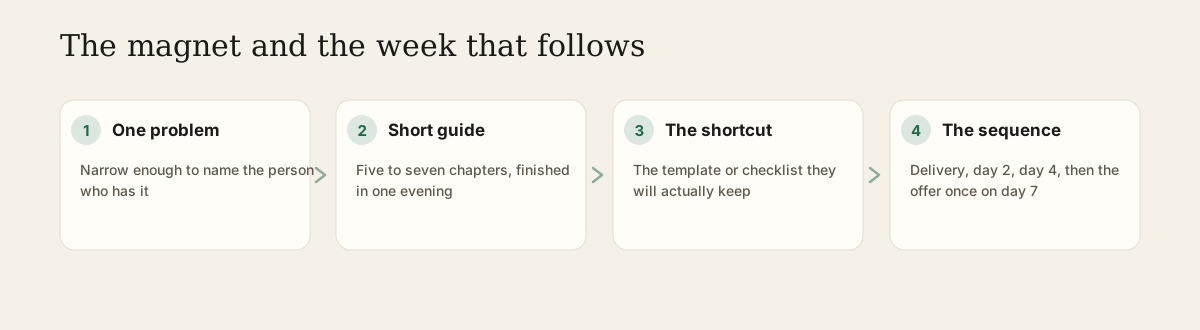
Aim for five to seven chapters of 600 to 900 words. That is a 30-minute read, which is the most a stranger will give you. Two reasons to be strict about this:
- Completion is the conversion. An unread 80-page PDF generates no trust. A finished 20-page guide generates a reply.
- Length signals effort to you, not to them. Nobody has ever said "this free guide was too short and therefore I distrust the author" about something that solved their problem.
The structure that works
- The cost of the problem — one page. What it is costing them now, specifically, in money, time or embarrassment.
- Why the usual advice fails — one page. This is where you earn the right to be read; name the common advice and explain its failure mode.
- The method, in steps — three or four chapters. One step each, with an example.
- The shortcut — the template, checklist, script or calculator. The thing they will actually use.
- What to do next — one page. The small win they can get this week, then the offer.
The last page is the whole business case
Most lead magnets end with a logo. End instead with: a one-paragraph summary of what they now know, one concrete action for this week, and one sentence about what you do for people who want the rest of it done for them. Ask a question, too — a reply is worth more than a click.
Neubook Write has a lead magnet kind tuned to this shape. It interviews you for the problem, the failed advice and your own examples, then writes five to seven short chapters and the closing offer page — in about ten minutes.
Start a book, freeDelivery: the sequence matters more than the document
A lead magnet that is delivered and never followed up produces almost nothing. The minimum viable sequence:
| When | Purpose | |
|---|---|---|
| Immediately | The download, and nothing else | Deliverability and trust. No pitch. |
| Day 2 | The single best idea from the guide, restated | Get value to people who never opened the PDF |
| Day 4 | A short case: someone who did this and what changed | Proof |
| Day 7 | The offer, plainly, once | Convert the ready ones |
| Ongoing | Useful email at a predictable interval | Stay welcome |
Two operational notes: send the file as a link rather than an attachment, so you can fix mistakes after the fact, and keep the download page on your own domain so you can measure it.
Consent, privacy and not being a nuisance
If any of your audience is in the EU or UK, the email you collect is personal data and the consent you take has to be specific. In practice: say on the form what you will send and how often, keep the download consent separate from the marketing consent, do not pre-tick boxes, and put an unsubscribe link in every email. The UK Information Commissioner's guidance on direct marketing is readable and free, and the GDPR summary covers the basics. In the United States, the FTC’s CAN-SPAM guide sets the floor: honest headers, a clear opt-out, and honouring it within ten days.
Where to put it
- A dedicated page with one job and no navigation. This is where your best conversion rate lives.
- Inside relevant posts, as a content upgrade tied to that post's topic. A magnet matched to the article beats a site-wide one every time.
- In your email signature and profiles, as a plain sentence with a link.
- As the reply to a question in a community you are actually part of — with the caveat that dropping links in communities you do not participate in gets you removed, deservedly.
Measuring whether it works
Three numbers, in order of usefulness:
- Emails per 100 visitors to the landing page. Everything else is downstream of this.
- Replies to the day-2 email. The best early signal that the content landed.
- Customers attributable to the list within 90 days. The only number that pays for the work.
If the first number is low, the offer does not match the visitor. If the first is fine and the second is zero, the guide is not useful enough. If both are fine and the third is zero, the sequence never asks for anything.
A one-day build
| Hour | Work |
|---|---|
| 1 | Write the one-problem sentence and the last-page offer. Everything else follows from these. |
| 2 | Outline five to seven chapters. Collect your own examples and numbers. |
| 3 | Draft. Read once. Cut every paragraph that is about you rather than them. |
| 4 | Build the template or checklist. This is the part they keep. |
| 5 | Landing page, consent copy, delivery email. |
| 6 | Write the four-email sequence before you publish, not after. |
Nine formats, ranked by how well they convert
The short ebook is the default, but it is not always the best trade. Ranked roughly by conversion rate for a well-matched audience:
| Format | Converts | Best when | Effort |
|---|---|---|---|
| Template or swipe file | Very high | They know what to do, they need the artefact | Low |
| Calculator or scorecard | Very high | The answer depends on their numbers | Medium |
| Checklist | High | A process with steps people forget | Low |
| Short ebook or guide | High | The problem needs explaining first | Medium |
| Email course | High | Behaviour change over days beats one document | Medium |
| Case study with numbers | Medium | Considered purchases, B2B | Low |
| Video workshop | Medium | Demonstration matters | High |
| Swipeable resource list | Medium | Curation is genuinely hard in your field | Low |
| Webinar | Low, but high value per lead | High-ticket services, live questions | High |
Notice the pattern: the artefact beats the explanation whenever the reader already understands their problem. Write the ebook when they do not.
The landing page, in seven lines
Most lead magnets are let down by the page that offers them. You need very little:
- A headline naming the outcome, not the format. "Stop losing a day a week to invoicing" beats "Free ebook".
- One sentence on who it is for, so the wrong person leaves without joining your list.
- Three bullets of what they will be able to do afterwards.
- An image of the thing — a real page or spread, not a stock mockup.
- The form: email only. Every extra field costs you conversions; ask for the name later if you need it.
- A plain consent line saying what else you will send.
- One line of proof — a number, a name, a short quote from someone real.
No navigation, no footer links, nothing else to click. The page has one job.
A worked example, end to end
A bookkeeper who wants clients among freelance designers:
- One problem: designers underpay or overpay advance tax because income is lumpy.
- Magnet: a seven-page guide plus a spreadsheet that takes four numbers and outputs the quarterly figure.
- Landing page headline: "Work out what to set aside this quarter, in about ten minutes."
- Delivery email: the file, and one sentence: reply with your worst month and I will tell you what I would do.
- Day 2: the single mistake most designers make, in 200 words.
- Day 4: a client who was setting aside 30 percent and needed to be at 18, with the arithmetic shown.
- Day 7: what working together looks like, one paragraph, one link, once.
The spreadsheet does the converting. The guide exists so the spreadsheet makes sense. The sequence exists so the guide leads somewhere.
What to do with the list after the first month
Most lead magnets fail not at the download but at week five, when the sequence ends and nothing follows. Decide before you launch:
- Cadence you can sustain. Monthly done reliably beats weekly abandoned in March.
- A format that is cheap for you. One useful thing you learned, one thing you changed your mind about, one link. Twenty minutes to write.
- A standing offer at the foot of every email, one line, never the subject.
- A cleaning rule. Remove people who have not opened anything in six months. Deliverability is a shared resource within your list, and dead addresses cost you the live ones.
Mistakes that quietly kill conversion
- Gating something that should rank. If the content would earn links and search traffic, publish it openly and gate the template instead.
- Asking for a phone number. Halves the conversion rate and annoys the people who do fill it in.
- An attachment instead of a link. Attachments trip spam filters and cannot be fixed after sending.
- No thank-you page. That page is your best chance for a second action — book a call, read the related post, reply.
- Making it about you. The reader is doing a trade, not joining a fan club. Every paragraph that is about your company is a paragraph they did not want.
The guide, the cover and the offer page in an afternoon. Describe the problem you solve and who has it; Neubook Write interviews you and writes the whole lead magnet, then exports a PDF you can host and an EPUB for readers who prefer it.
Start a book, freeSources
- ICO: Direct marketing guidance (UK)
- What is GDPR? A plain summary
- FTC: CAN-SPAM Act compliance guide for business
- Nielsen Norman Group: how users read on the web
Common questions
How long should a lead magnet be?
Five to seven short chapters, roughly 3,000 to 6,000 words. Anything longer competes with the reader’s evening rather than fitting into it.
Ebook, checklist or template?
A short ebook works when the problem needs explaining; a checklist or template wins when the reader already knows what to do and needs a shortcut. If in doubt, write the ebook and put the template in the last chapter.
Do I need consent language?
If you have readers in the EU or UK, yes. Consent for the download and consent for marketing email are separate: state plainly that you will also send occasional emails, and make unsubscribing easy.
What conversion rate is good?
For a well-matched offer on a focused landing page, 20 to 40 percent of visitors is achievable. A site-wide popup converts far lower. Judge by emails per 100 visitors on that page, not by a global number.
Should the lead magnet be gated at all?
Gate it when the email is the point and the content is genuinely worth the trade. Ungated content ranks and gets linked; gated content builds a list. Many businesses publish both versions of the same material.